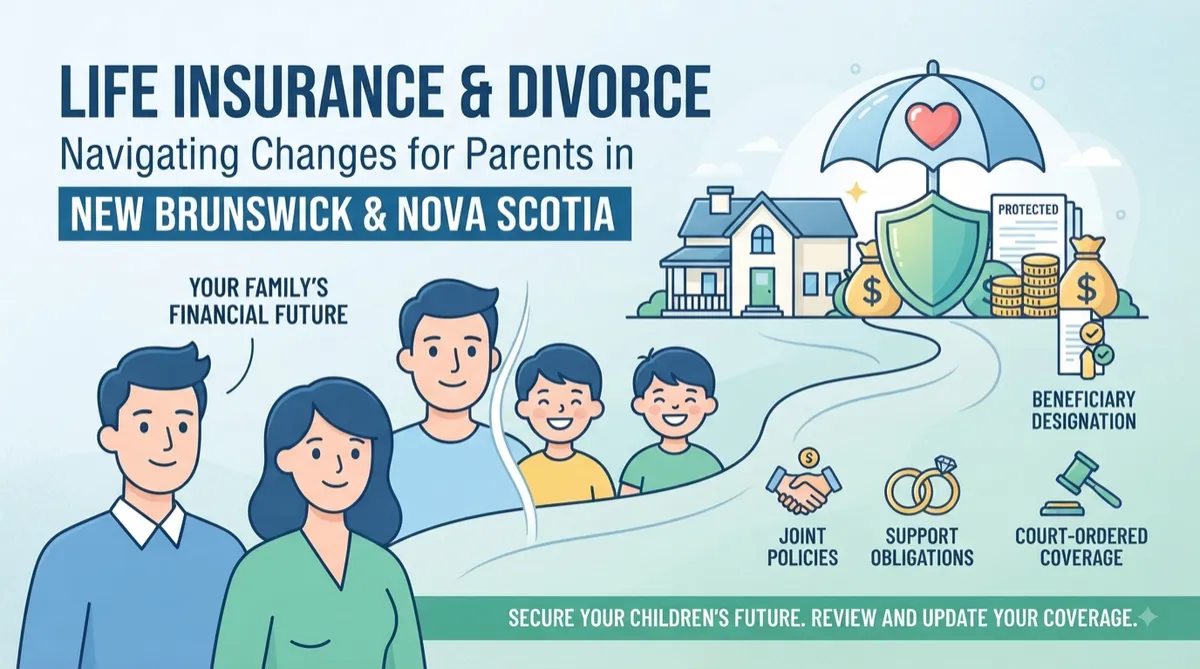
Life Insurance After Separation or Divorce
Life Insurance After a Separation or Divorce What New Brunswick and Nova Scotia Parents Need to Know
Separation and divorce change almost everything about a family's financial picture including life insurance that was set up years earlier and quietly forgotten. An old policy can still name an ex-spouse as beneficiary, a support order can require coverage that was never actually put in place, and a household that once shared one plan may suddenly need two. This article walks through what changes, what the courts expect, and how to protect your children's financial future during and after a separation.
Why Insurance Rarely Makes the To-Do List
When a marriage or common-law relationship ends, life insurance is almost never the first thing on anyone's mind. Dividing property, arranging parenting time, and settling support are what fill the calendar. Insurance tends to sit quietly in the background which is exactly the problem.
A policy purchased during the relationship doesn't update itself. Unless someone deliberately reviews it, it keeps running on the assumptions that existed before the separation: the same beneficiary, the same coverage amount, sometimes even the same joint ownership. Months or years later, families are often surprised to learn the policy never reflected their new reality at all.
How Separation Changes What Coverage You Actually Need
Before a separation, a couple's life insurance often protects a shared mortgage, a shared income, and a shared household budget. After a separation, those numbers rarely split evenly.
A parent paying child or spousal support now has an ongoing financial obligation that would disappear if they passed away unless it's backed by insurance. A parent receiving support is often more financially exposed than before, since they may be relying on a single income and a support order that has no guarantee behind it if something happens to the paying parent.
At the same time, housing costs typically go up, not down. Two households cost more to run than one, even with the same combined income.
📋Real-Life Example
Josée and Marc separated after eleven years together and share two children, ages 7 and 10, in Dieppe, New Brunswick. Their separation agreement requires Marc to pay $1,400 a month in child support until their youngest turns 19 a commitment worth well over $200,000 if paid in full. When Josée asked her broker what would happen to that support if Marc passed away unexpectedly, she learned the honest answer: nothing would replace it, because no insurance had ever been arranged to back the agreement. The couple's old joint policy from their mortgage years had lapsed months earlier without either of them noticing.
Court-Ordered Life Insurance to Secure Support Payments
It has become increasingly common for separation agreements and court orders in New Brunswick and Nova Scotia to require the paying parent to carry life insurance naming the receiving parent, or a trust for the children, as beneficiary. The goal is simple: if the paying parent dies before support obligations end, the coverage replaces those payments instead of leaving the other parent to absorb the loss.
Even when a court order or agreement doesn't explicitly require it, family law lawyers frequently recommend it as standard practice because a support order is only as reliable as the paying parent's ability, and continued life, to meet it.
•Coverage amount is often calculated to match the total remaining support obligation, not just a rough estimate
•Term life insurance is typically used, matched to the number of years support is owed
•Some agreements require proof of coverage be provided annually to the other parent or their lawyer
•The policy should be reviewed and adjusted as the support obligation decreases over time
•A lawyer can help determine whether your specific agreement requires this and how it should be structured
The Beneficiary Designation Trap
One of the most overlooked risks after a separation is a beneficiary designation that was never updated. In New Brunswick and Nova Scotia, a divorce does not automatically remove a former spouse as the beneficiary on a life insurance policy the way it can with a will in some circumstances. Unless the policy is specifically updated, or the separation agreement addresses it directly, an ex-spouse can remain the named beneficiary even years after the relationship ended and even after a new marriage or new children.
This is not a rare mistake. It happens quietly, often because updating a beneficiary form feels like a small administrative task that gets pushed aside during an emotionally difficult time.
•Review every existing life insurance policy after a separation, not just the ones connected to a mortgage
•Check group life insurance through work, which is easy to forget and rarely reviewed
•Coordinate beneficiary changes with your separation agreement and your will, since they should tell a consistent story
•If a policy is meant to secure support payments, the beneficiary designation should match the terms of the agreement exactly
•Revisit designations again after any future life change remarriage, a new baby, or a change to the support arrangement
What Happens to a Joint or Shared Policy?
Couples often purchase joint life insurance, sometimes called first-to-die coverage, to protect a shared mortgage or household income. After a separation, that arrangement rarely still makes sense the two people no longer share the financial obligation the policy was built to protect.
In most cases, a joint policy needs to be replaced with two separate individual policies, each sized to that person's own responsibilities going forward. This also gives each person full control over their own coverage, rather than remaining financially tied to a former partner through a shared policy neither of them may want to maintain.
Starting Fresh: Coverage for Your New Chapter
A separation is also a natural moment to build a protection plan around your life as it actually is now, rather than the life you had before. Many parents find that going through this process brings welcome clarity, replacing an outdated policy with one that genuinely reflects their current responsibilities.
This is also a good time to consider what happens if you are the one relying on support. A modest personal policy on the other parent, where it's affordable and appropriate, can add a second layer of security beyond what a court order alone provides and for some parents, personal savings or an emergency fund earmarked for this purpose plays a similar role.
•Recalculate your coverage needs based on your current income, housing costs, and parenting arrangement
•Consider your children's ages coverage that runs until your youngest is financially independent is a common benchmark
•Factor in any support you pay or receive as part of your ongoing financial picture
•Update or create a will alongside your insurance review, since the two work together
•If you're now a single-income household, consider whether disability insurance should be part of the conversation too
Common Mistakes Separated and Divorced Parents Make
Some patterns show up again and again when families go through this transition without a broker's guidance.
•Assuming an old joint policy automatically protects the new arrangement it usually doesn't
•Forgetting to check group life insurance through an employer, which often still lists an ex-spouse
•Letting a policy lapse during a financially stressful period, then struggling to qualify for new coverage later if health has changed
•Not confirming that a court-ordered coverage requirement was actually put in place, rather than just agreed to on paper
•Treating the insurance conversation as finished after the separation agreement is signed, instead of revisiting it as circumstances change
Building a Protection Plan for This New Chapter
Reviewing your life insurance after a separation doesn't need to be complicated, and it isn't something you need to figure out alone. A licensed broker can look at your separation agreement, your current responsibilities, and your family's specific situation, and help you build a plan that actually reflects where you are now.
•Gather your existing policies, including any group coverage through work, and confirm current beneficiaries
•Review your separation agreement or court order for any insurance requirements
•Calculate coverage based on your actual support obligations and household needs today
•Coordinate your insurance, beneficiary designations, and will so they tell the same story
•Set a reminder to revisit your coverage at each major life change going forward
The Bottom Line: Protect the Agreement You Worked Hard to Reach
A separation agreement represents real effort negotiation, compromise, and a plan for how your family will move forward. Life insurance is what makes sure that plan holds up even if the unexpected happens. Whether you're the parent paying support, the parent receiving it, or simply someone starting a new chapter, taking the time to review your coverage now protects everyone involved.
The best time to have this conversation is while your agreement is still fresh and your policies can still be adjusted not after a gap has already caused a problem.
Ready to Make Sure Your Coverage Matches Your New Reality?
At Bathurst Life Insurance Inc., we help families across New Brunswick and Nova Scotia navigate life insurance during separation and divorce clearly, honestly, and without judgment.
We're inviting you to request a free, no-obligation review of your current coverage and beneficiary designations. In one conversation, we'll help you understand what you have, what your agreement may require, and what options exist to protect your family going forward.
There's no obligation and no sales pitch. Just clear answers and real guidance.
📞Call us: 506-546-2186
🌐Visit us online: bathurstlifeinsurance.com
Serving families in Bathurst, Moncton, Fredericton, Halifax, and communities across New Brunswick and Nova Scotia.
Bathurst Life Insurance Inc.


